Leaks aren’t always easy to find, especially in a busy industrial facility where equipment noise can make escaping air difficult to hear or pinpoint.
At Central Air Equipment, we use LeakShooter ultrasonic leak detection technology to locate, photograph, and document leaks throughout your compressed air system. Our technicians identify where air is being lost and provide clear information about each detected leak, helping your team understand the impact and prioritize repairs.
In a noisy facility, compressed air leaks can easily blend into the sounds of everyday production. That makes it difficult to pinpoint exactly where air is escaping and which areas need attention.
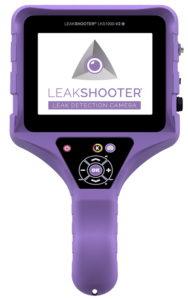
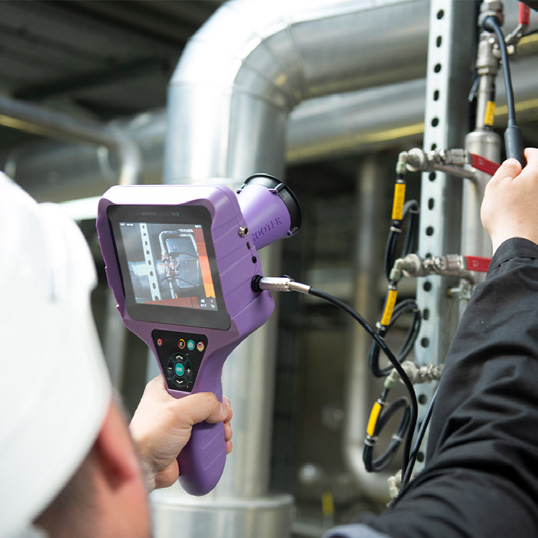
Using the LeakShooter LKS1000-V2 ultrasonic leak detection camera, CAE can detect ultrasonic sound produced by escaping air and visually pinpoint the source of the leak. The technology can be adjusted to filter out unwanted background noise, making it useful in active industrial environments.
Once a leak is located, our technician can photograph and document its precise location for your report, giving your maintenance team a clear place to start.
Every compressed air leak is air your system worked to produce but your facility never gets to use. As leaks add up, they can increase system demand, waste energy, and leave less available compressed air for the equipment and processes that need it.
Finding and addressing those leaks can help your facility:
A compressed air leak detection survey gives your team a clearer picture of where air is being lost and what to address first, helping turn hidden air loss into an actionable maintenance plan.
Compressed air leaks waste energy every time your system is running. Even leaks that seem small can add up over time, increasing operating costs without adding anything to your production.
This single leak pictured here was estimated to cost $1,692 per year—showing why identifying and prioritizing leaks matters.
What You’ll See for Each Leak:
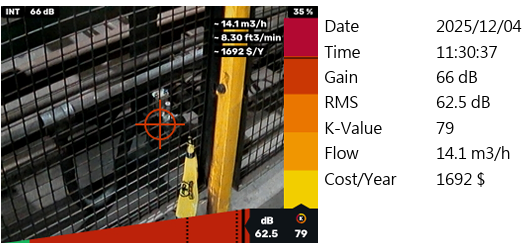
Here’s what to expect. Your report helps you understand where leaks are occurring, how significant they are, and what they could be costing your facility.
Your report may include:
Know exactly where identified leaks are located
See documented images of identified problem area
Understand which leak deserves attention
See estimated air loss associated with identified leaks.
Understand the potential cost associated with compressed air loss.
Give your maintenance team clear information for follow-up.
Best when:
Your main concern is finding where compressed air is escaping.
✓ Locate leaks
✓ Document problem areas
✓ Estimate leak flow/cost
✓ Prioritize repairs
Best when:
You’re experiencing broader compressed air system performance or efficiency problems.
✓ Pressure concerns
✓ High energy consumption
✓ Compressor Sequencing
✓ Storange & demand issues
Central Air Equipment owns and operates its own LeakShooter ultrasonic leak detection equipment. That allows CAE to provide focused leak detection as part of its advanced diagnostic and system optimization services.
You don't just need someone to tell you that your system has leaks. You need to know where they are and which ones matter most. Leak documentation gives your maintenance team useful information for planning and prioritizing repairs.
Sometimes a leak survey uncovers a straightforward maintenance issue. Other times, excessive air demand or performance problems point to something happening elsewhere in the compressed air system. CAE can support the equipment, service, parts, diagnostics, and broader compressed air system needs that may come after the survey.
A compressed air leak detection survey is a focused inspection used to locate air escaping from a pressurized compressed air system. CAE uses ultrasonic leak detection technology to identify and document leaks that may otherwise be difficult to locate during normal plant operation.
Compressed air escaping through a leak produces ultrasonic sound. The LeakShooter detects these ultrasonic signals and visually guides the technician toward the source. Once the source is identified, the location can be photographed and documented.
Leaks can occur throughout compressed air piping, connections, valves, hoses, couplings, equipment, and other components. LeakShooter technology is designed to detect ultrasonic leaks in compressed air and other pressurized gas and vacuum systems.
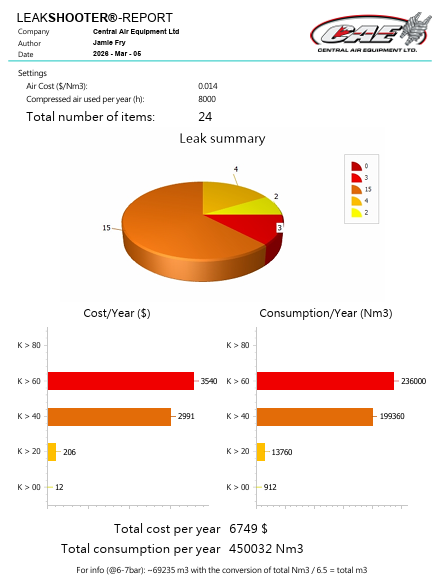
Depending on the agreed scope, your results can include documented leak locations, photographs, severity information, estimated flow, estimated annual compressed air consumption, estimated annual cost, and an overall summary of the leaks identified.
The LeakShooter reporting format can estimate flow and annual compressed air consumption for identified leaks. It can also calculate an estimated annual cost using the operating information entered into the report. CAE’s sample report includes both individual leak estimates and system-wide totals.
No. Leak detection specifically focuses on locating and documenting compressed air losses. A full compressed air audit evaluates the system more broadly and may examine factors such as pressure, demand, compressor operation, storage, and energy use. CAE can help determine which service is appropriate for your facility.
You shouldn’t have to guess whether compressed air leaks are contributing to higher operating costs or unnecessary system demand.
Central Air Equipment can locate and document leaks throughout your compressed air system and give your team the information needed to prioritize repairs and take action.
We use cookies to improve your experience, analyze traffic, and support marketing. You can accept all, reject non-essential cookies, or customize your choices.
California users can reject marketing cookies to opt out of sale/share or targeted advertising.